
Yavapai County Lookup Record Paths
A sound one-person search starts by choosing the record that fits the question. The Yavapai County assessment roll can connect a person or entity to a parcel, while the Recorder index can show a party role in a deed, lien, or release. Arizona court tools point toward public cases. Historical vital images help with family history. Business and license sources show public affiliations. Each source proves a narrow fact, so its label matters.
| Record | Fact It Can Support | Official Route | Access Boundary |
|---|---|---|---|
| Assessment roll | Current parcel owner and mailing addressee | Yavapai County Assessor/GIS | Owner is not necessarily occupant |
| Recorded documents | Party, instrument date, and parcel link | Yavapai County Recorder | General index verified from 1904 |
| Court record | Public party and case trail | Arizona Public Access, eAccess, then Clerk | Protected and sealed classes omitted |
| Historical vital image | Old birth or death facts and family clues | ADHS Genealogy Search | Public image is not certified |
| Business or license | Principal, agent, license, or trade role | ACC, SOS, or the relevant board | Role or business address is not residence |
Use the most precise key first. An APN, document number, case number, entity ID, or license number is safer than a common surname. With only a name, retain the exact indexed spelling and try initials, suffixes, hyphens, and known variants. A Yavapai County resident lookup becomes credible only after two independent details agree. A matching name by itself is not enough.
Confirming One Yavapai County Resident
Verification means separating the person from other people with the same name and keeping every record role distinct. A parcel owner may receive tax mail elsewhere. A grantor sold an interest. A statutory agent accepts legal service for a company. None of those labels alone establishes a present home. Use the following confirmation sequence when an address or parcel clue is available.
- Search the Yavapai County Assessor/GIS map. Record the APN, standardized situs address, owner name, mailing address, and jurisdiction that actually appear.
- Search the Recorder document gateway for the owner and spelling variants. Match the parcel or legal description before accepting a hit.
- Check a precise public identifier in another source, such as a case number, entity ID, license number, known middle initial, date, or associated party.
- Ask the record custodian for the exact file or copy needed. Correct an error with that office rather than treating a downstream compilation as authoritative.
- Docket
- The ordered list of filings and events in a court case.
- Index versus image
- An index points to a record; an image reproduces the underlying document.
- Certified copy
- An official copy authenticated by the custodian, often for a separate statutory fee.
When the web ends, use the counter, phone, email, or mail channel. The Clerk accepts specific court-record requests in person, by email, by mail, and by phone. The Recorder and Assessor have Prescott and Cottonwood counters. A narrow request with a number, date, and document title gives staff a far better key than “everything about” a name.
Yavapai County Court Lookup Layers
The Arizona Public Access portal is a weekly summary index across participating courts. Its modes include case search, minute-entry search, and case notification. Court selection covers Yavapai Superior Court as well as listed justice and municipal courts. Yet the portal is not the official case file. It omits sealed cases and several protected classes, including probate from the public summary. A missing name can reflect an exclusion, a delay, or a nonparticipating record.
| Layer | Best Use | Key Limit |
|---|---|---|
| Public Access | Find a public court and case reference | Weekly summary, not official file |
| eAccess | Selected Superior Court civil and criminal documents | Coverage and account conditions vary |
| Yavapai County Clerk | Verify and request the official public file | Confidential or sealed material needs authority |
The Arizona eAccess source shows the separate document channel used after an index search.
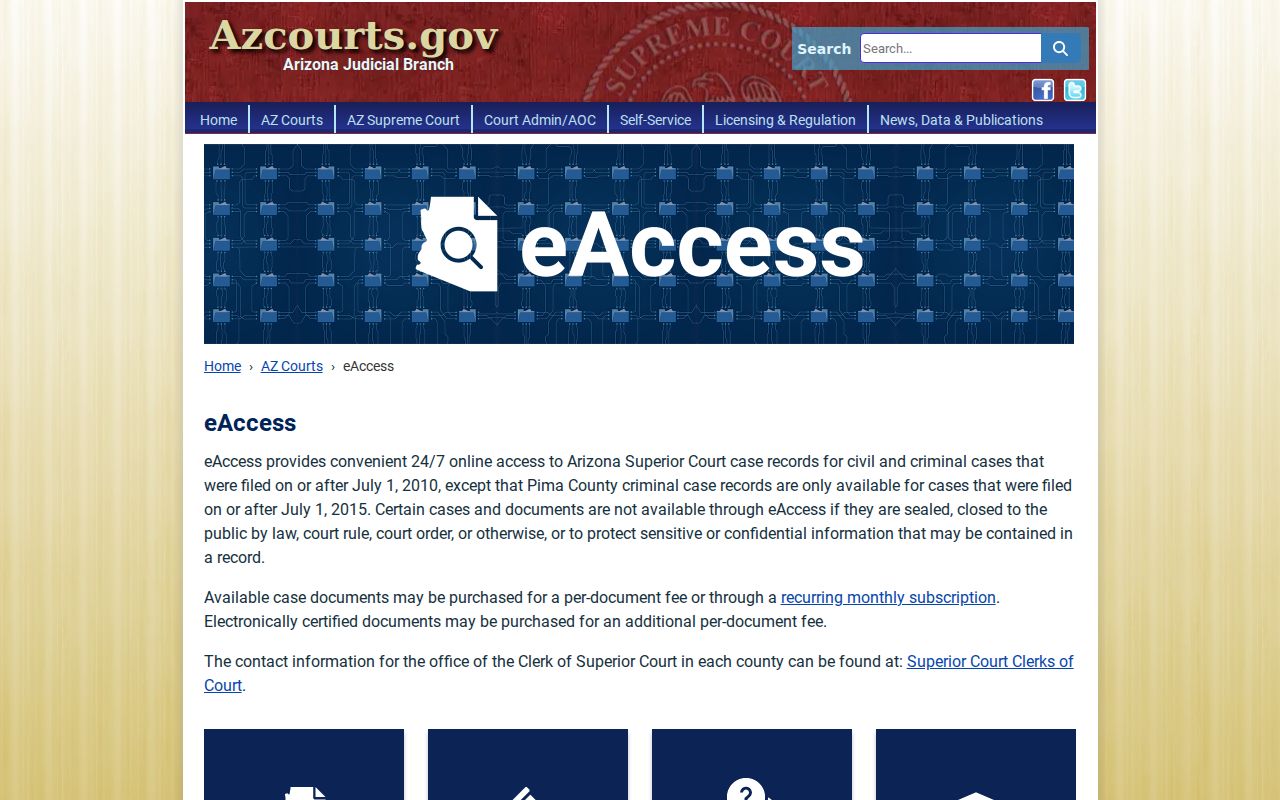
This distinction is crucial: record the court, case number, type, and visible event first, then request the named document from the Clerk. Pre-1992 Yavapai County files go through the historic courthouse route at 120 South Cortez Street, Room 207. Ordinary copies are listed at $0.50 per page, while certification adds $35 plus pages. Those are Clerk copy charges, not a general price for every identity search.
Note: The statewide court index updates weekly, so a recent event may reach the official Clerk file before it appears online.
Historical Yavapai County Resident Records
Arizona's historical vital channel resolves old identities without opening modern certificates to all searchers. Under A.R.S. §36-351, birth certificates transfer for public archival access 75 years after birth and death certificates 50 years after death. The ADHS Genealogy Search reported birth coverage from 1855 through 1945 and death coverage from 1870 through 1970 during research. Its images are useful evidence for genealogy, but they are not certified copies.
The official historical search page illustrates the image route available for one-person research in Yavapai County.
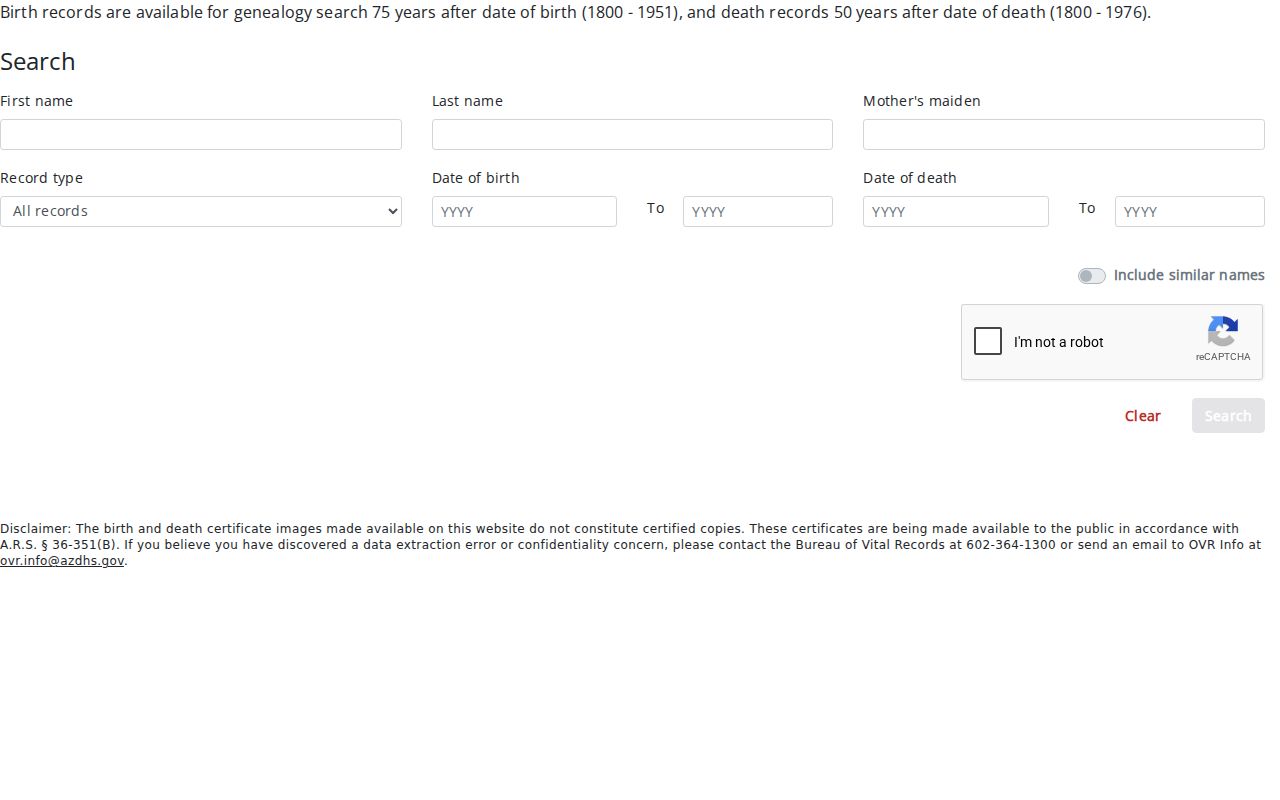
The coverage notice and public image channel help establish a name, event date, place, or family clue. A person who needs formal proof must still use an authorized certificate route through Arizona Vital Records or the local registrar. Marriage licenses and divorce decrees remain with the Yavapai County Clerk, not ADHS.
For an eligible death-certificate request by mail, the current state form calls for an original signature, fee, self-addressed stamped envelope, relationship evidence, and either a clear front-and-back copy of signed government photo ID or a notarized signature. Cash should not be mailed. Birth requests use their own current form and eligibility rules, so death-form choices should not be carried over.
Yavapai County Lookup for Heirs
An heir search is a good example of why one official portal cannot answer the whole question. Probate is excluded from Arizona's statewide public court summary, so begin with the Yavapai County Clerk record request. Supply the decedent's name, an approximate filing date, and a case number if known. Ask for a named public item, such as an inventory, judgment, decree, or dated minute entry.
Then compare the probate clue with an obituary, a historical death image, or the Arizona Unclaimed Property search. The state search and claim are free. A deceased-owner claim requires proof of heirship and identity; source, value, and property details remain protected until the claimant proves entitlement. That privacy step is not a failed resident lookup. It is part of the lawful process.
Arizona Voter Lookup Boundaries
My.Arizona.Vote is an individual self-service route for registration status, polling place, ballot-by-mail status, and provisional-ballot status. Identity-matching details entered into the form do not become a public output. A.R.S. §16-168 separately controls the voter file, its authorized uses, protected fields, fees, and secure delivery. It does not create a general name directory.
The public precinct register can include a full name, party preference, registration date, and residence address. The electronic list may include added fields allowed by statute. Month and day of birth, government identifiers, family security details, signatures, and email are not ordinary public fields. Participation history shows only that a person took part in an election, never a ballot choice. Protected voters may have information sealed under A.R.S. §16-153.
For a current error, contact Yavapai County Recorder/Elections. For historical work, the indexed Yavapai voting collection covers 1875 through 1932 and contains 157,847 entries, but its old forms must be read in their own era. Modern voter rules should not be projected backward onto territorial records.
Note: A self-lookup and a regulated voter-file request are separate channels with different purposes, fields, and safeguards.
Business Roles in Identity Records
The Arizona Corporation Commission Entity Search can match an entity name, statutory agent, principal, or entity ID, with filters such as entity type, status, name type, and county. An entity ID is the cleanest key. A principal is tied to the organization, and a statutory agent accepts legal service. Neither role proves that the listed business or agent address is the person's home.
A public entity profile can return several distinct facts:
- The entity name and precise Entity ID.
- The entity type and status shown by ACC.
- Named statutory-agent and principal roles.
- Business or agent addresses attached to those roles.
Arizona has no single professional-license database with identical fields for every field. The state license directory routes searchers to the responsible board. Keep the board name, license number, profession, public status, and issue or expiration date together. For technical registrations, the public output can include name, status, profession, city, ZIP, and limited discipline history. A board record can confirm a public credential or place clue without establishing current Yavapai County residence.
Correct Yavapai County Resident Records
Official errors belong with the office that keeps the source. An owner or parcel issue goes to the Assessor. A recorded instrument is not rewritten; ownership changes through a later recorded document, and indexing questions go to the Recorder. Court-file questions go to the Clerk. Voter registration is updated through Recorder/Elections. License status belongs with the issuing board.
Commercial compilations are different. They merge data from many dates and may join two people who share a name. Use the provider's privacy or removal process, save confirmation, and recheck later. Removing a compiled listing does not erase an official public record. Likewise, correcting the official source may take time to flow into other databases. The safest Yavapai County resident lookup cites the source and retrieval date instead of presenting a compilation as final.
Lawful Yavapai County Resident Lookup
Arizona access law opens many government records, but it does not turn protected data into a public directory. The Address Confidentiality Program provides a substitute address and mail forwarding for qualified survivors. Separate statutes can suppress eligible Recorder, Assessor, Treasurer, and voter information through the court process. Suppression is specific relief. It does not promise that every old public document will vanish.
MVD addresses are protected by federal law. Sealed court files, protected voter details, modern vital certificates, utility accounts, and private contact lists also fall outside an ordinary resident lookup. If a source withholds a field, do not try to reconstruct it by merging other clues. Public access is a limit as well as a permission.
Lawful use. Use a Yavapai County resident lookup for lawful personal research, family history, an heir matter, or scam verification. Never use records to stalk, harass, intimidate, or expose a protected person.
Arizona Public Records Law, chiefly A.R.S. §§39-121 through 39-121.03, provides inspection and prompt-copy rights for existing public records. When no portal result appears, identify the exact custodian and request a specific record by date, number, name, or parcel. Ask for a segregated public copy if part is confidential. There is no universal response-day promise, and an office need not create a custom resident directory.