
Yavapai County Directory Runs
The core online shelf is the Arizona Memory directory collection. It returned ten digitized titles during research, beginning with a Prescott volume and continuing through county and city books with many missing years. The viewer offers page images, OCR text, and downloads. OCR, or optical character recognition, turns a scanned page into searchable text, but old type and initials can be misread. A search hit is therefore a pointer to the page image, not a substitute for it.
| Directory collection | Years represented | Repository | How to use it |
|---|---|---|---|
| Prescott city and business books | 1903-1904, 1937, 1939 | Arizona Memory | Free online images and OCR |
| Yavapai County directories | 1913, 1916 | Arizona Memory | Free viewer and PDF |
| Prescott city directories | 1948, 1953-1954, 1961 | Arizona Memory | Free online access |
| Luskey's criss-cross book | 1963 | Arizona Memory | Name and reverse-address browsing |
| Prescott and Humboldt additions | 1951, 1952, 1953 | Sharlot Hall Research Center | Appointment or remote request |
These dates are stops, not a continuous annual series. The 1948 book was published by Prescott Courier, Inc., while Arizona Directory Company of Phoenix issued the verified 1913 and 1916 county books. No source inspected established the final printed directory year. Gaps should remain visible in a family timeline rather than being filled by guesswork.
County Books Beyond Prescott
The 1916 Yavapai County Directory names private citizens and business firms in Prescott, Jerome, and principal county towns. Its classified pages and appendices also cover officials, courts, schools, churches, clubs, and societies. Those extra sections can distinguish two people with the same initials. An occupation or a firm name may connect an alphabetical listing to a classified advertisement, while a school or club listing may explain why the name appears in that town.
Countywide in a title does not mean every person was listed. Rural residents, people without a published address or telephone, temporary workers, and people recorded under household conventions can be absent. The correct claim is that a person was or was not found in the available volume. It is not proof of presence or absence from Yavapai County.
Note: Search surname variants and initials, then inspect the pages before and after every OCR result.
Read Yavapai Directory Entries
A local entry is compact evidence. The inspected 1916 and 1961 samples confirm surname, given name or initials, occupation or status, and sometimes an employer or business link. Business entries can add an organization, proprietor or manager, street or road address, post-office box, and telephone exchange. A 1961 number in the HI 5 format is a period clue, not a modern contact number. Spouse, widow, and household-tenure marks were not verified in the inspected samples, so they must not be assumed.
| Printed field | What the verified Yavapai sample may show |
|---|---|
| Personal name | Surname plus given name or initials |
| Work detail | Occupation, status, employer, or business affiliation |
| Place detail | Street or road address and sometimes a post-office box |
| Business detail | Organization with a proprietor or manager in parentheses |
| Telephone | Period exchange and number in some later books |
Read the book's own title page and key before interpreting a mark. Publishers changed form and scope. A word that means residence in one book may not appear at all in another, and a classified heading is not the same as an alphabetical household entry.
- Criss-cross directory
- A book arranged by street or telephone number so a known place can lead to a listed person or business.
- Householder index
- An address-based section that names the listed party tied to a street number, when a volume includes one.
- Abbreviation key
- The publisher's explanation of shortened words and marks used in that specific volume.
Reverse the 1963 Directory
Luskey's 1963 title is the confirmed reverse directory in the collection. It explicitly includes Prescott, Bagdad, Chino Valley, Humboldt, and Mayer. Start with the street section and the number used in 1963. Browse nearby numbers because OCR often confuses digits and because the printed street order reveals gaps. Record the listed occupant or business and phone, then check the same name in the alphabetical pages.
Reverse access answers who was listed at an address in that publication, not who owned the parcel or every person who stayed there. A deed, census record, obituary, or newspaper can test the identity. Modern address work belongs in the Yavapai County street directory, where parcel and recorder records are keyed to present streets.
Uneven Yavapai Directory Geography
The 1953-1954 directory is full for Prescott and its immediate area, yet it provides names-only lists for more than thirty outlying communities. Those places include Ash Fork, Bagdad, Camp Verde, Clarkdale, Cottonwood, Crown King, Jerome, Mayer, Seligman, Skull Valley, and Yarnell. This is a notable geography quirk. A thin entry outside Prescott can reflect the publisher's format, not a person's lack of an address or local ties.
Prescott's dense run also reflects the county seat's older street grid and stronger publication history. Remote mining, ranching, and homestead areas leave different trails in voting records, land files, newspapers, and institutional collections. A Yavapai County city directory search should therefore begin with the book's stated coverage, then shift repositories when the place received only a short list.
Cross-Check Yavapai Directory Names
The archive's obituary, cemetery, census, and resident indexes offer a strong second check. The captured index page shows the types of name-based collections available beyond a printed city directory.
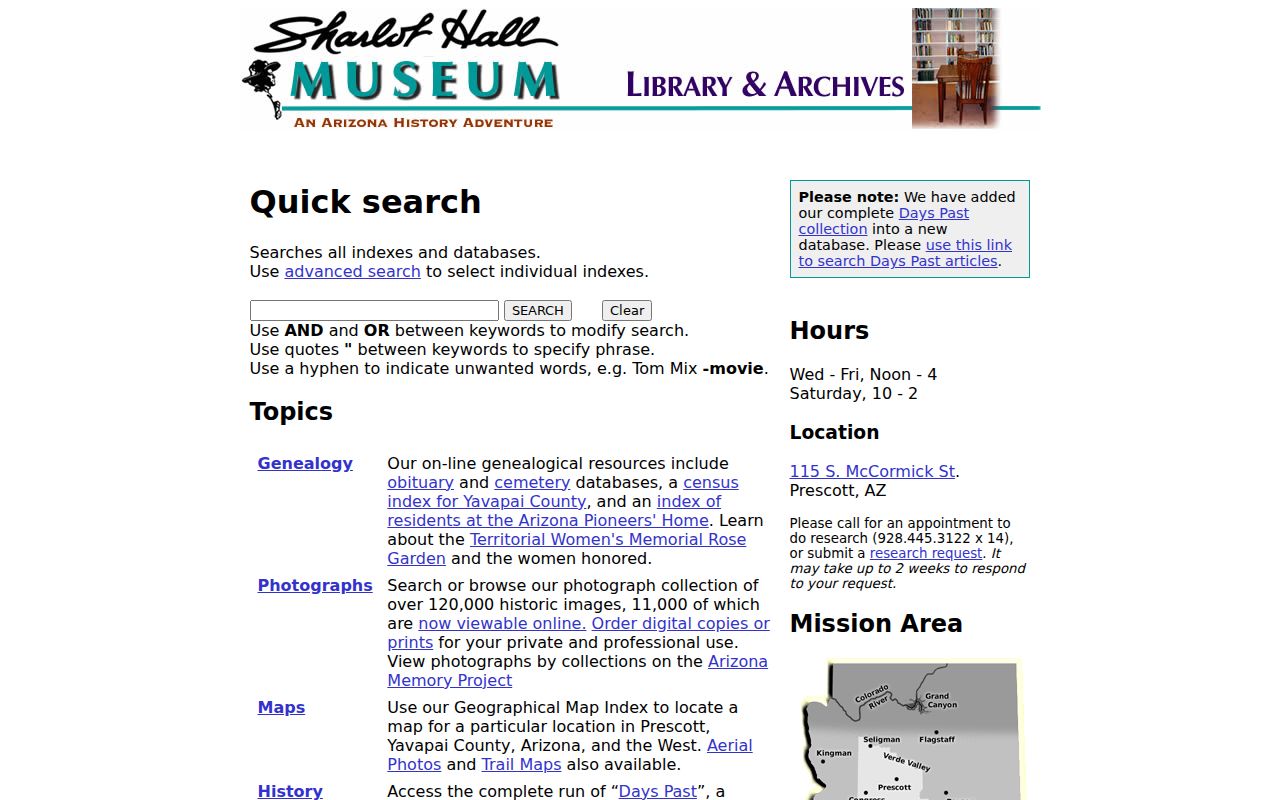
An obituary can help explain a disappearance between volumes. Cemetery and census entries may separate same-name people, while the Arizona Pioneers' Home ledger supplies an unusual institutional residence trail. Its indexed collection covers 1911 through 2000 and contains 2,848 records. Yavapai voting records from 1875 through 1932 add 157,847 indexed civic records, though their fields must be read under the rules of the historic collection rather than modern voter-file assumptions.
Note: Treat an online name index as a lead, then inspect the linked record or ask the holding archive for the source image.
Trace Yavapai Directory Families
A sound timeline keeps each source in its own role. Directory entries report a printed listing. Census schedules report a household at a census residence. Deeds report parties to a land transfer, while maps show a building or parcel context. Pairing the records can show continuity without claiming that a listed occupant owned the land.
- Normalize surname variants, initials, suffixes, and any historic street form. Begin with the closest available directory year.
- Read the alphabetical entry and check the classified and institutional sections for work or civic links.
- Move across the uneven year run. Record each address exactly and leave publication gaps blank.
- Use the 1963 criss-cross section for a known address, then confirm the name in its alphabetical section.
- Pair early books with the 1900, 1910, and 1920 censuses. Pair later books with released census records through 1950.
- Test a move or disappearance with newspapers, an obituary, cemetery evidence, a deed, or another dated record.
A missing listing has several possible causes. The person may have moved, died, been omitted, appeared under initials, or lived in a community covered only by names. The sequence supports a conclusion only after another record narrows those choices.
Map Yavapai Directory Addresses
The 1890 Prescott Sanborn map has seven public-domain sheets. It can place a directory address near a building footprint and show period use, but it is not a list of occupants. Prescott was laid out in 1864 with broad streets and government blocks, so its early grid works well with map and directory evidence. Later subdivisions and county E911 numbering follow a different system.
Boundary history matters too. Yavapai County began in 1864 at roughly 65,000 square miles and became known as the Mother of Counties. Places later assigned to other Arizona counties can still appear in early Yavapai material. Match the event year to the boundary of that year before labeling the locality. This single step prevents a territorial directory find from being forced into today's county map.