
Start a Yavapai Residents Search
A useful Yavapai County residents directory search starts with the strongest known fact. An address points first to the county parcel map. A name can be tested against property, deed, court, business, license, archive, and historical vital indexes. An old address belongs in the directory, deed, census, newspaper, and map trail. These sources do not all mean “resident.” They identify such roles as owner, grantor, court party, license holder, registered voter, or person listed in a past publication.
Keep the exact spelling, date, source, and record number from each result. Match at least two independent details before deciding two entries concern one person. An APN, which is the assessor’s parcel number, is far stronger than a shared surname. Likewise, a case or document number makes a clerk request precise. No result can prove that every person in a household has been found.
- Search the county GIS by address or owner and record the situs address, APN, owner, and legal description.
- Use the owner’s name and parcel details in the Recorder index, checking spelling variants and party roles.
- Check the Arizona court index, historical vital index, or regulated voter channel only when each source fits the question.
- For earlier residents, move to Arizona Memory directories, Sharlot Hall indexes, census records, newspapers, and maps.
- When a web index stops, contact its custodian by phone, mail, email, or at the counter with exact identifiers.
Yavapai Residents Records Desks
Three county desks form the core of the modern Yavapai County residents directory trail. The Recorder indexes deeds and other recorded instruments. The Assessor maintains the current property roll and parcel facts. The Clerk of Superior Court holds the official court file, including probate files that do not appear in the statewide public summary. Prescott serves as the county seat, yet Cottonwood and Camp Verde channels matter for Verde Valley research.
The Recorder and Assessor operate counters in both Prescott and Cottonwood. Web access is a first pass, not the only route. Staff can quote copies, explain an identifier, and help locate older books, but a request should name a person, parcel, document, case, date range, or record type.
Yavapai County Recorder
1015 Fair Street, 2nd floor
Prescott, AZ 86305
928-771-3244 option 6
Yavapai County Assessor
1015 Fair Street, 1st floor
Prescott, AZ 86305
928-771-3220
The Yavapai County Recorder services page shows the official office route behind the recorded-document search.
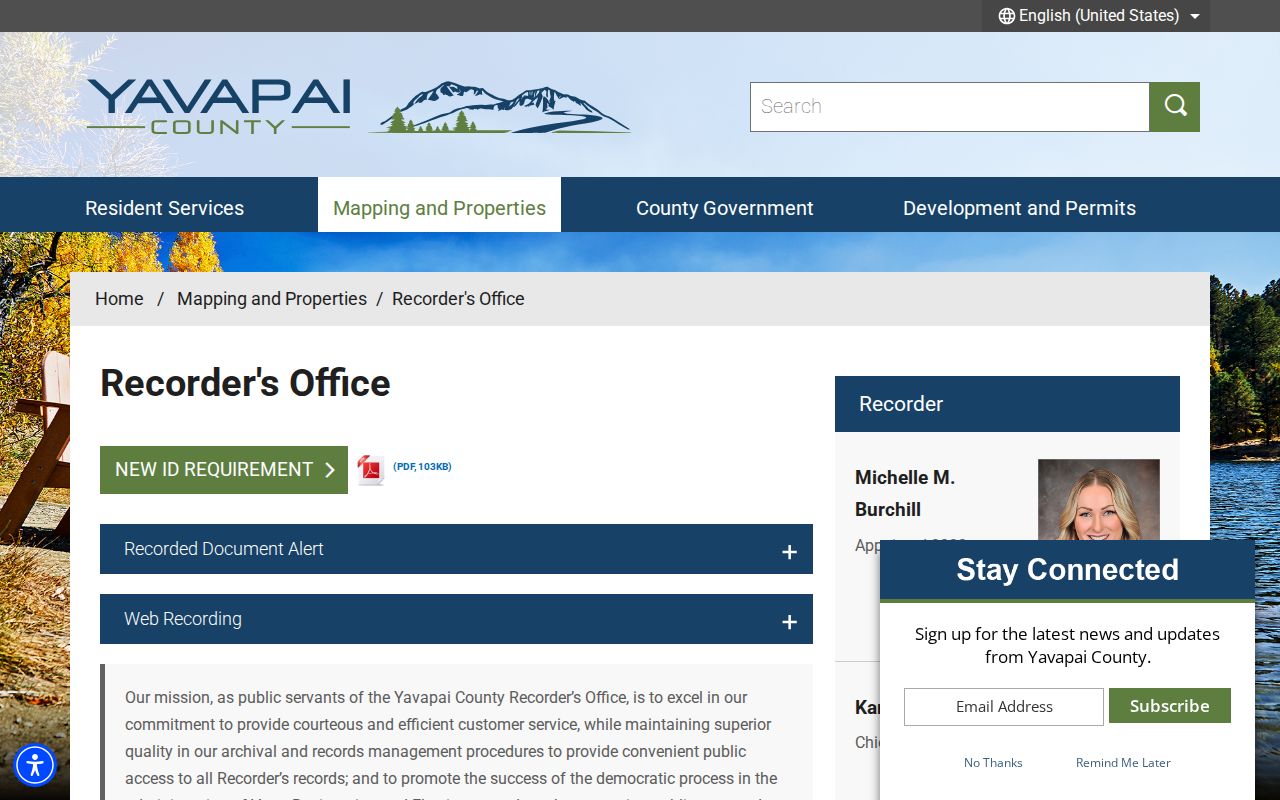
The office page keeps the online index, counter help, contact details, and recording services tied to the custodian that can verify a document.
Yavapai Directory Geography Comes First
Yavapai County covers more than one urban center. Prescott is the county seat, while Cottonwood, Camp Verde, Sedona, Jerome, Clarkdale, Prescott Valley, Chino Valley, Dewey-Humboldt, and remote rural places have their own local record patterns. County Development Services handles permits and addressing for unincorporated land. Incorporated cities and towns may keep those same types of files themselves. A postal city does not settle which government created a permit.
Use the parcel map to identify the jurisdiction before sending a request. This step prevents a common dead end: asking the county for a city permit or asking a city about land beyond its limits. Sedona provides a sharp example because ZIP 86336 crosses the Yavapai and Coconino county line. ZIP codes route mail; they are not legal boundaries.
Note: A Prescott mailing label may describe unincorporated county land, so confirm the parcel and jurisdiction before choosing a custodian.
Yavapai Parcel Lookup Fields
The Yavapai County GIS and parcel search connects a current address with its mapped parcel. Search a street number and road name without city, state, or ZIP. Then record the APN, standardized situs address, current owner, owner mailing address, legal description, and subdivision or lot details actually shown. Situs means the physical parcel address. A mailing address is where tax correspondence goes, and the two may differ without proving where anyone lives.
| Search choice | Input | Best use | Important limit |
|---|---|---|---|
| Address | Street number and road | Locate a physical parcel | Omit city, state, and ZIP |
| APN / parcel | Parcel identifier | Link records across offices | Copy the live format exactly |
| Owner | Person or entity name | Find possible owned parcels | Owner is not always occupant |
| ZIP or place | Geographic term | Move to a broad map area | Not proof of jurisdiction |
| Road or district | Map category | Understand service geography | Not a resident list |
- Parcel
- A mapped unit of land tracked under an APN.
- Roll
- The assessor’s official list of taxable and nontaxable property.
- Index
- A finding aid that points to a record but may not be the record itself.
- Criss-cross directory
- A historical directory arranged by street address rather than only by surname.
Current Yavapai Resident Sources
No current source lists all Yavapai County residents. Each official system covers a defined event, legal role, or public duty. The property roll is broad but lists owners, not every occupant. Recorded documents identify parties to land and other filings. Court systems list public cases, subject to exclusions. My.Arizona.Vote is an individual verification tool, while a voter file request has strict statutory purposes and use limits.
| Official source | Connection shown | Keeper | Access path |
|---|---|---|---|
| Assessment roll | Current parcel owner and mailing data | Yavapai County Assessor | GIS, counter, or focused records request |
| Recorded document index | Grantor, grantee, and other filing parties | Yavapai County Recorder | Online index, Prescott or Cottonwood counter |
| Court index and file | Public case party and case events | Arizona courts and local Clerk | State index, eAccess, email, mail, phone, or counter |
| Historical vital index | Older birth and death identity clues | Arizona Department of Health Services | Free genealogy image search |
| Directory collections | People or firms listed in selected years | Arizona Memory and Sharlot Hall | Digital viewers, appointment, or remote request |
Official systems disclose their scope and custodian. Commercial lookup products combine data from many places, may lag a correction, and may merge people with similar names. They cannot replace an official index or certified copy. The focused Yavapai County resident lookup workflow shows how to test one name across records without treating a match as proof of residence.
Yavapai Heir Lookup Trail
Estate research may begin with a Yavapai probate file and continue through the Arizona Department of Revenue unclaimed-property search. The free state route accepts an owner name and explains the evidence needed for a claim.
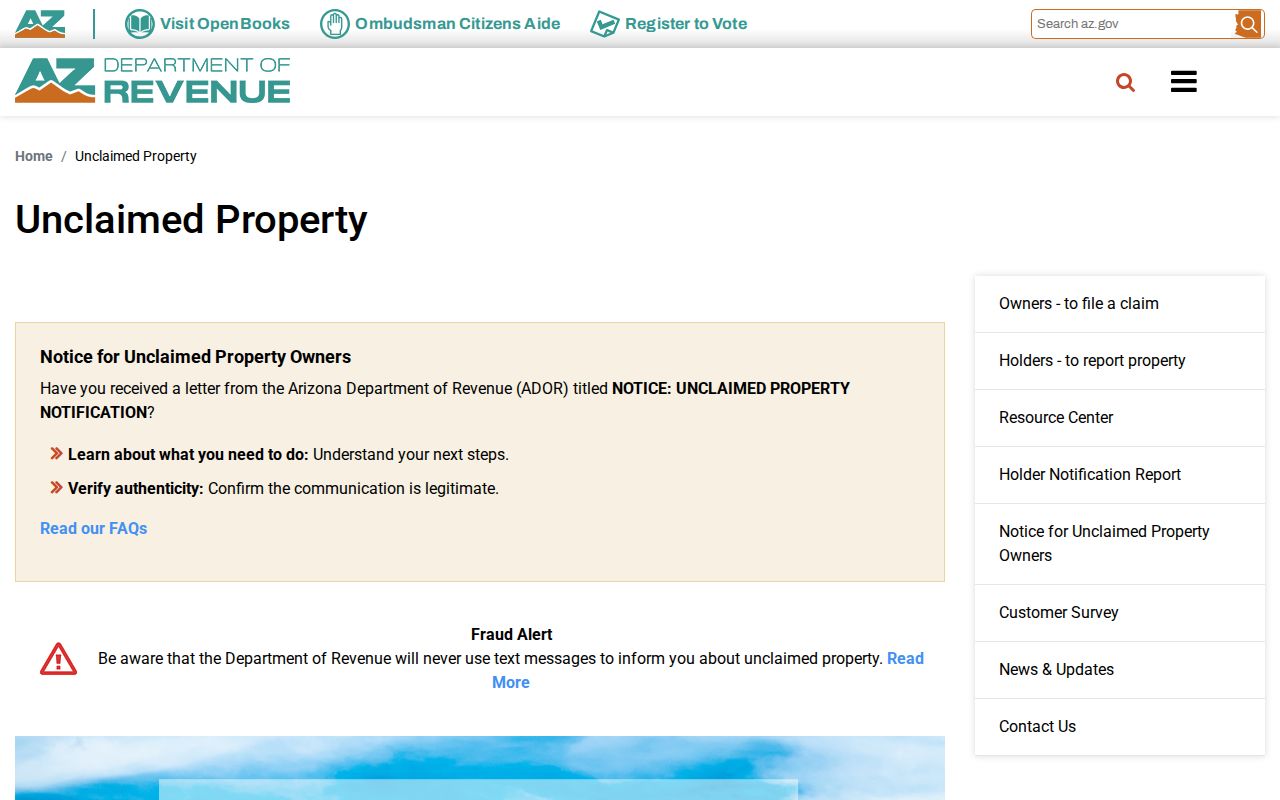
A search result is a lead, not proof that two similar names identify the same person. An heir may need probate documents and proof of heirship before the state can release property.
Yavapai Jail Lookup Limits
The Yavapai County jail search takes a last name and reports a timestamped roster result with inmate number, booking date and time, location or unit, and the person's formatted name.
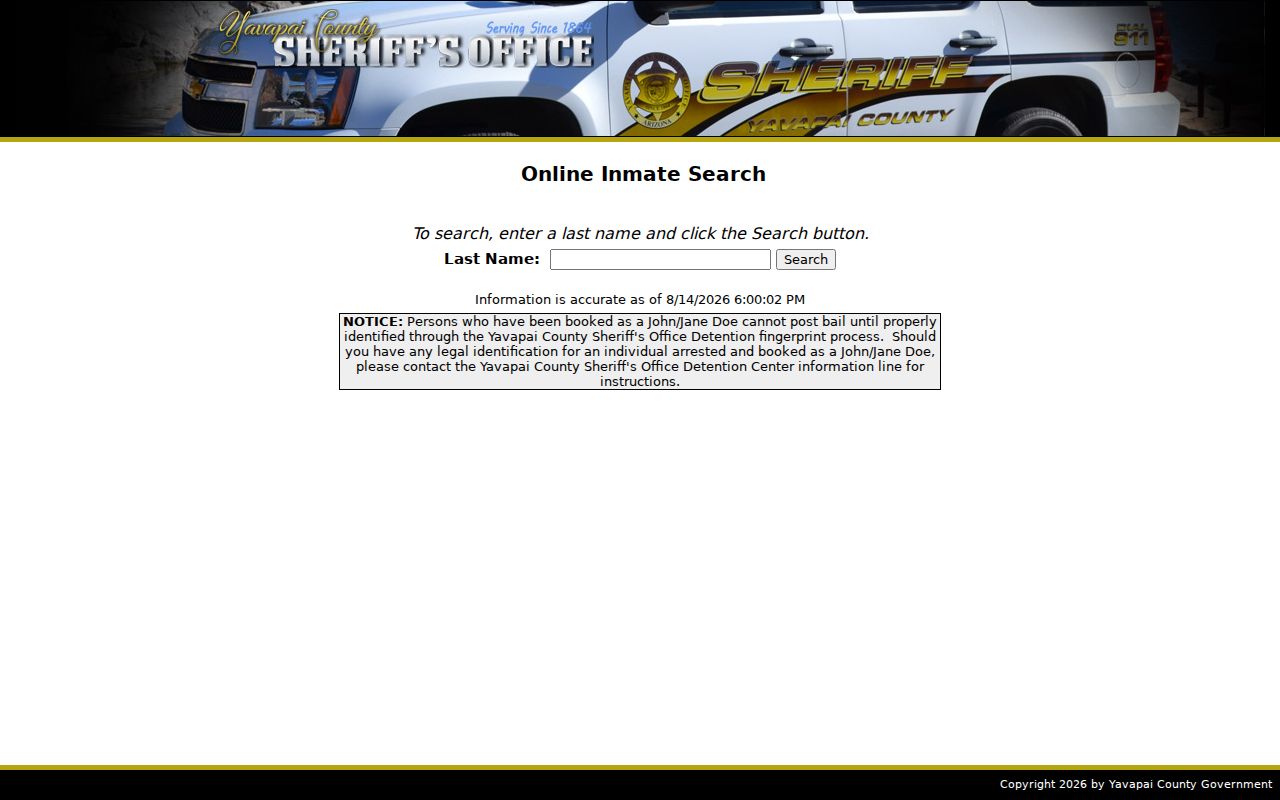
Booking data describes custody at the stated update time. It is not a conviction record and does not prove a current home address, so any court question must return to the named court and official case file.
Confirm Yavapai Court Name Matches
The Arizona Public Access to Court Information system is a statewide lead. It covers participating superior, justice, and municipal courts and updates weekly. It is not the official file. Sealed records, probate, protective orders, mental-health cases, protected victim or witness information, and several juvenile or family matters are excluded from the public summary.
Record the exact court and case number from a possible match. Then use eAccess for eligible Superior Court documents or contact the Yavapai Clerk for the official docket or copy. The Clerk accepts in-person, email, mail, and phone requests. Pre-1992 files go through the Prescott courthouse route. A same-name case must be checked against public dates, middle names, roles, and jurisdiction.
The official court-search screen shows why the index is only the first layer. The Arizona court portal supplies court and search modes before a clerk verifies the file.
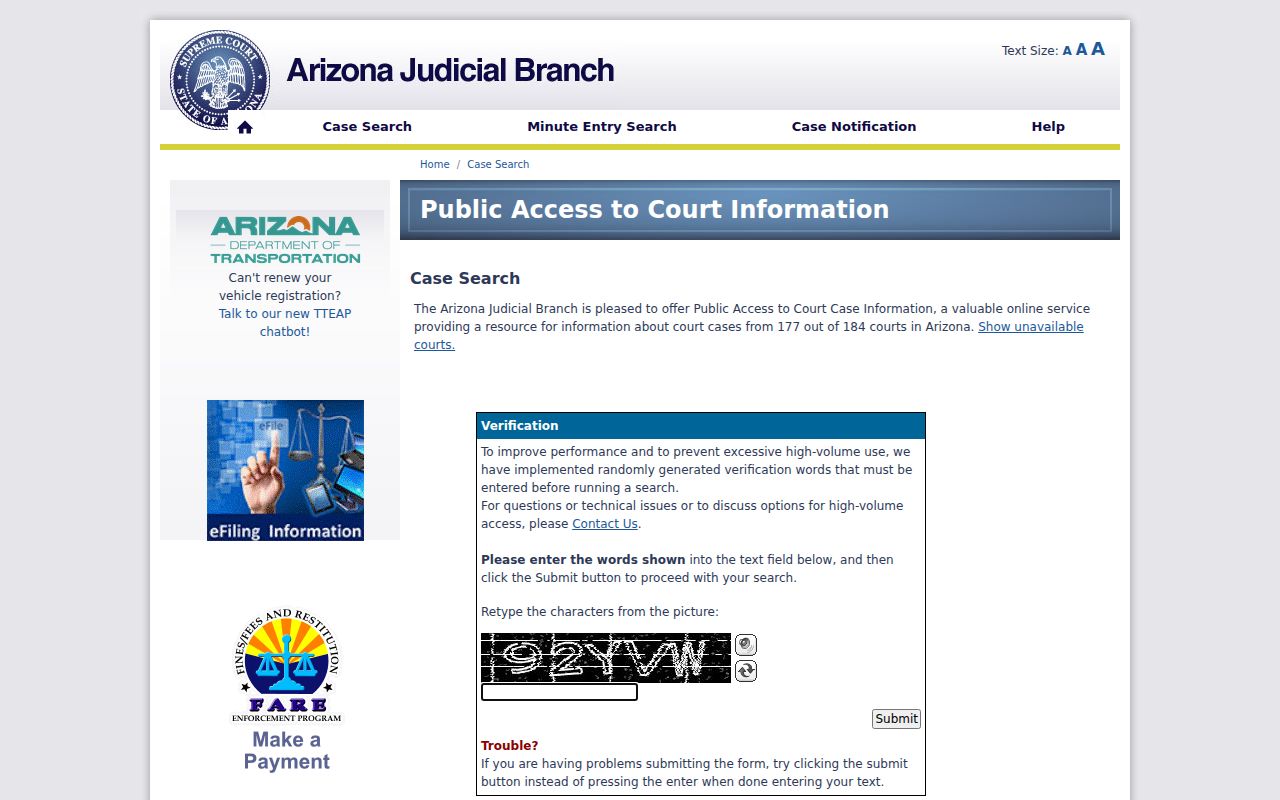
Its statewide reach helps locate the custodian, while the named Yavapai court remains the source for an official record and correction.
Yavapai Voter Records Have Limits
My.Arizona.Vote lets an individual verify registration, polling place, ballot-by-mail status, and provisional-ballot status. It is not an open browse of everyone on a road. Arizona law allows defined fields in an official voter file, but full dates of birth, identification numbers, signatures, security-related family data, and email remain confidential. Participation history shows only whether a person took part in an election, never a ballot choice.
A.R.S. §16-168 limits voter-list use to listed political, election, redistricting, and other legally authorized purposes. The County Recorder can provide the current request process and statutory fee calculation when the purpose qualifies. Protected voters may have identifying data sealed under §16-153, and Address Confidentiality Program participants receive further safeguards.
Use Yavapai County records only for lawful personal, civic, property, or family research. Never use a directory trail to stalk, threaten, harass, or defeat a protected address.
Yavapai Vital Records Open Slowly
Arizona separates historical genealogy images from certified vital records. Under A.R.S. §36-351, birth certificates move toward public archival access 75 years after birth and death certificates after 50 years. At the research date, the ADHS genealogy search reported births from 1855 through 1945 and deaths from 1870 through 1970. Those images aid family history but are not certified copies.
Certified birth and death copies remain eligibility controlled through Yavapai County Community Health Services or the Arizona vital records hub. Marriage licenses and divorce decrees belong with the Clerk and court, not ADHS. A missing web result may reflect the release clock, an index variant, or the wrong custodian rather than the absence of an event.
The state’s vital-record page helps distinguish a genealogy image from an official certificate. The ADHS ordering hub routes current certificate requests.
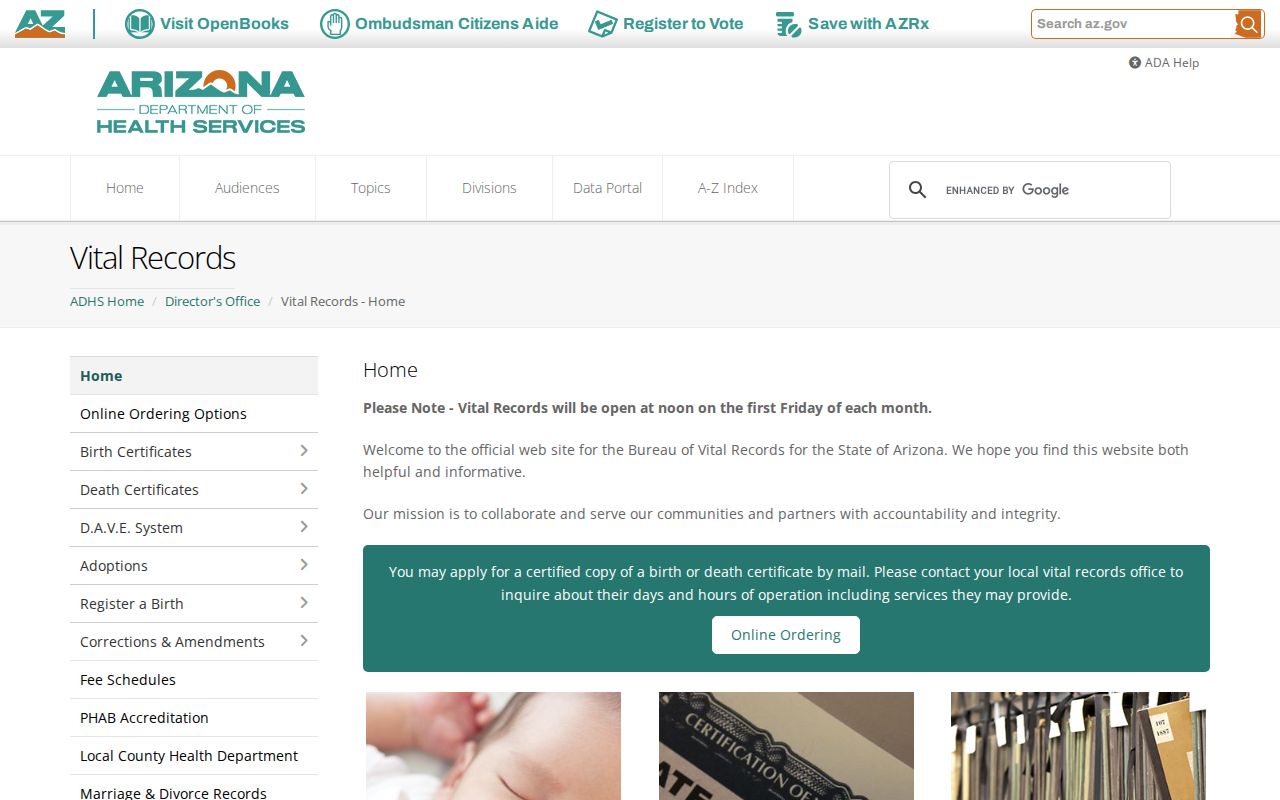
That distinction matters when a family-history clue later must be supported by a certified record from an eligible channel.
Yavapai Recording Alerts Need Review
The Yavapai County Recorder offers a free Recorded Document Alert for an individual or business name. It emails basic recording data and a document link after a matching name is indexed. The county says it was the first Arizona county to introduce the program. This alert is useful for noticing a new filing, yet it does not block a document, guarantee title, or prove fraud.
Common names can produce unrelated alerts. Open the linked instrument, inspect the party role, document type, date, and parcel details, then contact the Recorder through a published channel if the filing appears wrong. The same care defeats many record scams. A 2025 local court warning described callers impersonating court or law-enforcement staff over supposed missed jury duty. Independently call the office rather than using a caller’s number.
Note: Official record access can verify a claim, but urgency, unusual payment demands, and caller-provided contact details are reasons to pause.
Historic Yavapai Residents Directory Shelf
The historical Yavapai County residents directory trail is unusually rich but uneven. Arizona Memory provides ten digitized Prescott and county directory titles spanning 1903–04 through 1963, with gaps. The 1916 Yavapai County Directory names Prescott, Jerome, and principal county towns. The 1963 Luskey’s volume is the confirmed criss-cross source and includes Bagdad, Chino Valley, Humboldt, and Mayer. It can move from an era-correct address to a listed person or business.
The Sharlot Hall Museum Research Center adds physical directories, phone books, yearbooks, newspapers, obituaries, cemetery data, maps, and personal collections. It is a free, noncirculating library at 115 S. McCormick Street in Prescott and works by appointment. Remote research starts with 30 free minutes, then uses the center’s stated hourly service and response window. The full Yavapai County city directory collections deserve separate treatment because publication scope varies sharply between Prescott and outlying communities.
Directory absence is not proof of absence. Rural residents, people listed under initials, households outside a publisher’s area, and those omitted from a given edition can be missed. Confirm a directory clue with a census, obituary, newspaper image, deed, or historical vital record.
Mother of Counties Record Puzzle
Yavapai began in September 1864 as one of Arizona Territory’s four original counties. It covered about 65,000 square miles and became known as the Mother of Counties as all of Apache, Coconino, Gila, and Navajo counties, plus parts of several others, were carved from it. An early “Yavapai” record may therefore describe a place outside today’s county lines.
Time and geography must be read together. Prescott’s 1864 street grid, the 1864 newspaper trail, maps and surveys reaching back to 1864, the seven-sheet 1890 Prescott Sanborn map, homestead files, territorial voting registers, and later directories each capture a different landscape. Mining claims and land surveys show claim parties and places, not ordinary household occupancy. Early research should map the event date against the county boundary of that year.
Beyond Yavapai Online Directory Results
Online access ends at different points. The Recorder’s general document index is verified from 1904 forward, while subdivision maps and land surveys reach 1864. The statewide court index omits whole protected classes and is not official. Assessor data describes a current roll. The historic directory run is not annual. These boundaries call for a fallback chain, not a guess.
Start with the counter or custodian that owns the record. Recorder staff in Prescott and Cottonwood can assist with official copies and older book references. The Assessor can explain current parcel data. The Clerk accepts email, mail, phone, and in-person requests and routes older files through the historic courthouse. For an identifiable existing government record, Arizona Public Records Law, especially A.R.S. §§39-121 through 39-121.03, supports inspection and prompt copy access subject to lawful confidentiality and fee rules.
Archives fill the historical side. Arizona Memory supplies digital images and OCR. Sharlot Hall offers closed-stack local material and a remote request service. State Archives and FamilySearch catalogs can bridge territorial, homestead, voting, institutional, and deed-book gaps. Cite the collection, locality, date span, and known name or identifier. A narrow request is far more likely to reach the right volume than a request for “everything” about a person.